
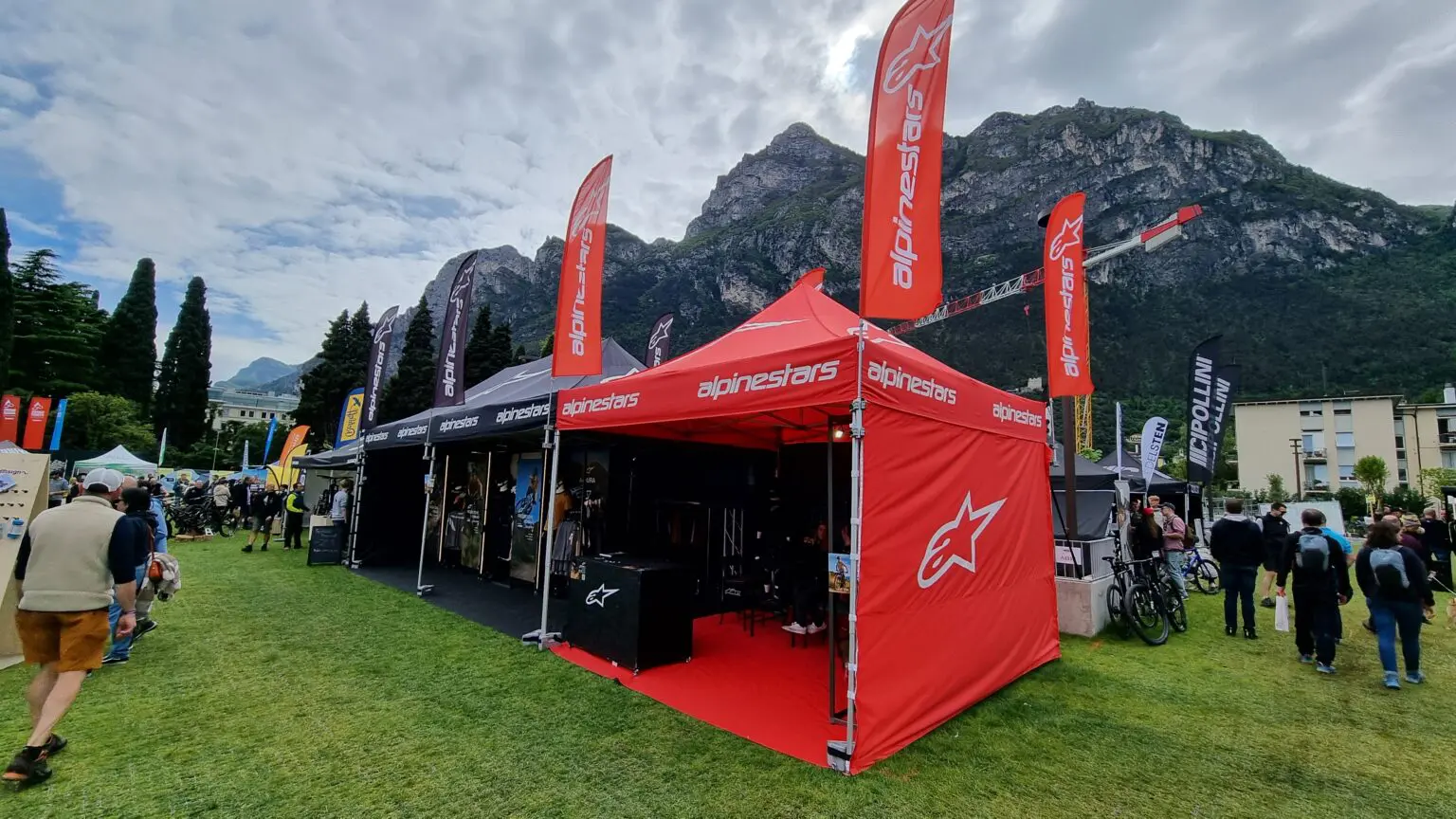
Tip 1: Whenever possible, look for a “brand-name product” rather than a no-name tent!
Securing a folding pavilion against wind begins at the moment of purchase. A brand-name product is called that for a reason; usually, there is a well-thought-out “brand” behind it that forms the basis for long-term, high-quality production. Manufacturers, importers, or dealers of the brand consciously choose a brand because they want to build and support a market in the long term. A low-quality product would only damage the brand’s reputation and, consequently, the reputation of the tent manufacturer or seller. Therefore, when you purchase a brand-name product, you can largely trust that great care was taken in the selection of materials, which is especially important for the stability of the scissor-style tent.
Brand-name products are sometimes more expensive than no-name products, but this is usually because more expertise and, above all, higher-quality materials are used in these products, which ultimately drives up the product price. With no-name products, the focus is usually only on keeping the price as low as possible, as there is no “commitment” to a brand. It is therefore advisable to invest a little more money, which pays off and yields a return or amortizes in the long run, and this usually translates directly into the stability of the tent.
Tip 2: Pay attention to the construction of the tent
Read the specifications from the tent manufacturer or dealer carefully and pay particular attention to the construction of the tent. Profile wall thickness is not the only factor determining the stability of a folding tent. It is the “total package” that ultimately defines a high-quality pop-up tent. A large profile wall thickness is useless if the connecting elements are too weak. In many folding tents, for example, the scissor profile is only screwed to the connecting part on one side, which is not necessarily conducive to the stability of the tent. Therefore, ensure that the scissor profile is guided “into” the connecting element and screwed tight there. This way, the aluminum profile is held or supported on both sides, which enormously increases the stability of the foldable tent. Whether the connecting parts should be made of plastic, aluminum, or steel is a question of the overall package. Each of these elements has advantages and disadvantages.
Tip 3: Suitable accessories for stabilizing the folding tent
Especially with brand-name products, you will find numerous accessories that can be used to stabilize the folding pavilion. Whether your tent is a trade show tent, party tent, garage tent, event tent, or market tent, stabilization of the pavilion may be necessary for all these areas and more.
Tension straps and pegs/ground nails:
With brand-name products such as the Expotent folding tent from Expotrade Group, tension straps and ground nails (also called pegs) are included as standard with the folding tent frame. Inside the robust carrying bag of the frame, there are suitable storage compartments so that all parts can be neatly stowed away and not lost. If you are setting up your folding tent on soft ground, it is recommended to secure the tent using the supplied tension straps. These are primarily attached to the corners and, depending on the tent size, also in the middle, then tensioned diagonally to the ground and secured in the soil with the pegs. The tension straps can then be adjusted and tightened as required. On the Expotent folding tent, a “red” loop is also attached to the tension strap, which signals where to pull and also warns of a potential tripping hazard when the strap is tensioned.
Base plates / weights:
If you are setting up your tent on hard ground and cannot use the included tension straps/pegs, we recommend purchasing so-called base plates or weights. For Expotent folding pavilions, such base plates are available in 15 kg and 25 kg weights. Depending on the size of the tent, it is advisable to opt for the heavier weights, as wind can possess a force that should not be underestimated. For Expotent folding tents, the weight is simply placed on the inside of the tent onto the triangular foot of the folding tent. Due to the triangular shape of the weight plate, the plate fits flush with the shape of the tent, and there are no outward-protruding parts that could lead to tripping hazards. Furthermore, this ensures that any side walls attached to the tent also fit flush with the tent. The Expotrade weights also have a Velcro strap integrated into the plate, which is simply wrapped around the tent leg when placing the plate on the stand and then reattached to the plate. This Velcro fixation prevents the plate from slipping during strong winds and tent movements. The base plates can also be stacked on top of each other to use even more weight depending on the requirements and size of the tent.
DIAGONAL connecting bars
– the patented solution from Expotrade for wind problems.
A patented solution available only from Expotent! A bar attached “diagonally” between the folding tent legs stabilizes the folding tent with a double effect! Due to the rigid design of this diagonal bar, tensile and shear forces occurring on the folding pavilion are optimally absorbed, keeping the tent perfectly in shape. This diagonal connection looks visually like the scissor profile in the roof construction of the folding tent but is fixed at eye level between the legs. A telescopically extendable aluminum profile facilitates fixation, and the plastic screw connections around the leg can be adapted to almost all common folding tent profiles using the supplied inserts. Thus, the Expotent diagonal connecting bar can also be fixed to other folding tents from competitors. If you frequently set up your tent in windy areas and want suitable protection against wind, the diagonal connecting bar from Expotrade is the perfect solution for your problem. In addition, this stabilizing bar protects against the “bulging of side walls” in strong winds. In strong winds, the side walls attached to the tent act like a sail and naturally form a large wind-attack surface. With a mounted diagonal bar, the side wall is caught by the cross-bracing, making tearing of the Velcro fasteners or side wall attachments virtually impossible.
Ask about Expotent special solutions at office@expotradegroup.com or by phone. +43 5576 73600.
Horizontal connecting bars:
There is also the option of using a horizontally attached bar between the legs. This horizontal connecting bar is primarily fixed to the legs at a height of approx. 1 m using a screw fastener. For support in the middle, brand-name products usually also include a vertical leg. This supports the horizontal telescopic bar and prevents sagging over large spans, such as 4.5 m in length. For example, half-height side walls can be fixed to this horizontal bar. In this case, the stabilizing bar is simply pushed into the hem/tunnel of the half-height side wall, and the 1/2 side wall then essentially hangs from this bar. Due to full-surface printing, even more advertising space can be utilized. For Expotent folding tents, these bars are also packed in a handy carrying bag so that nothing can be lost.
Roof with ventilation flap:
In addition to the measures mentioned above, tent roofs with ventilation flaps can also be used. For Expotent folding tents, there is a perfect solution for this. A so-called ventilation flap or ventilation opening is attached to the peak of the roof, which is normally sewn shut. A mosquito net is sewn into the open part at the roof peak so that the stability of the fabric or the roof is still maintained despite the opening. A so-called roof dome is then placed on this mesh roof peak and fixed to the roof. A small reinforcement is also sewn into the lower side edge of this dome so that the dome is held upwards, allowing air to circulate. Such roofs are used specifically in windy areas and thus also contribute to the stabilization of the tent, as part of the wind pressure is dissipated via this air circulation through the roof dome. Such tents with smoke extraction are often used, for example, as smoking tents in front of restaurants, etc. Another product from Expotrade already has this roof dome integrated as standard on every roof – ask about the Expodome dome tents!
Tip 4: Wind tests for folding tents
Some tent manufacturers have also tested their tents against wind, although these tests should always be taken with a grain of salt. If a manufacturer specifies wind speeds of up to 100 km/h in its description, for example, this should certainly be questioned, as these may have been optimal conditions used during the test, which are rarely encountered at outdoor events. Therefore, look at the “total package” of the manufacturer or the product as described above.